Global projects rarely fail because people are not talented enough. More often, they fail because ownership is unclear, communication is fragmented, decisions are delayed, and no one is fully responsible for turning many moving parts into one successful outcome. This is why the difference between international project management and international project coordination matters.
Both are important. Both support global teams. But they are not the same.International project coordination keeps people, meetings, updates and information aligned. International project management goes further: it owns delivery, risks, scope, quality, timelines, stakeholder expectations and final outcomes.
For global software, AI, EdTech, HealthTech or R&D projects, coordination alone is rarely enough. What global teams really need is a structured combination of coordination, technical project management, clear governance and delivery ownership.
What Is International Project Management?
International project management is the process of planning, leading and delivering projects across countries, teams, time zones, cultures and organisations.
In practice, it includes:
- defining project scope and objectives;
- managing timelines, milestones and deliverables;
- aligning business, technical and stakeholder expectations;
- coordinating distributed software or product teams;
- managing risks, dependencies and changes;
- ensuring quality, accountability and delivery progress;
- supporting communication between clients, partners and engineering teams.
The Project Management Institute describes project management as the use of specific knowledge, skills, tools and techniques to deliver something of value. In international projects, this value is delivered through people who may never sit in the same office, work in the same time zone or follow the same organisational culture.
In international software projects, project management also includes a technical layer. The project manager or technical project manager must understand requirements, architecture, development workflows, QA, release planning, technical dependencies, security considerations and product priorities. This does not mean the project manager replaces the technical lead. It means they create the structure that allows technical teams, business stakeholders and external partners to work toward the same outcome.

What Is International Project Coordination?
International project coordination focuses on keeping the project organised and connected.
A project coordinator may support:
- scheduling meetings;
- preparing agendas and notes;
- following up on partner inputs;
- collecting reports or status updates;
- maintaining documentation;
- coordinating communication between teams;
- tracking action points;
- helping partners stay informed.
In international projects, this role is valuable because teams often work from different countries, follow different internal processes and operate in different time zones. However, coordination is mainly about alignment and support. It does not always include full responsibility for scope, budget, delivery decisions, technical risks or final project outcomes.
Project Management vs Coordination: The Core Difference
The easiest way to understand the difference is this:
Project coordination keeps the project moving. Project management makes sure the project arrives at the right destination.
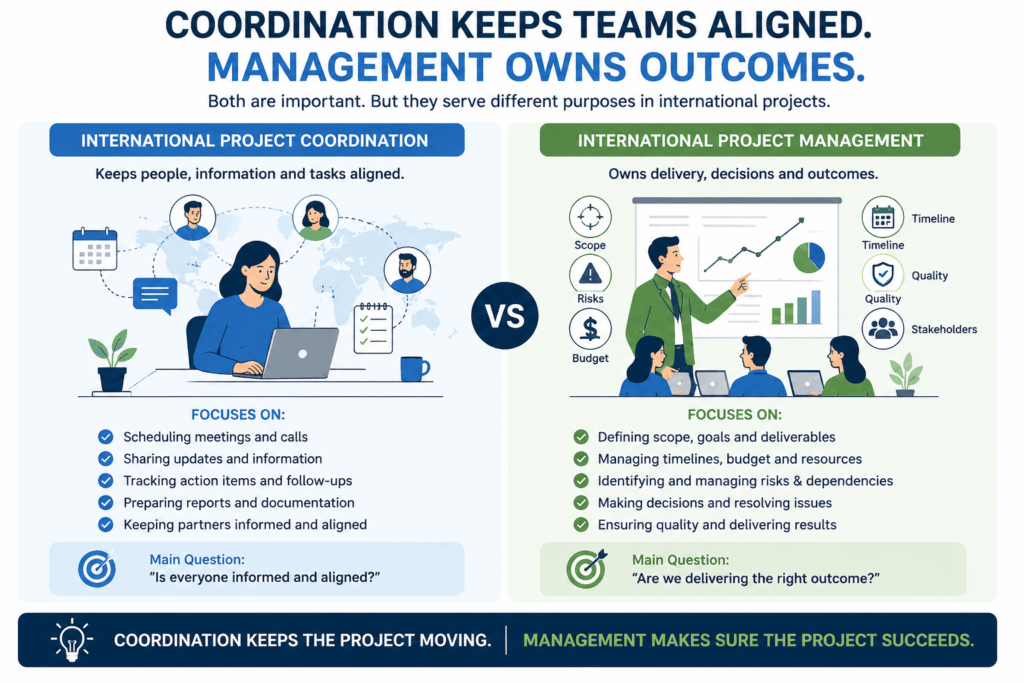
A coordinator may ensure that everyone joins the meeting. A project manager ensures that the meeting leads to decisions, decisions become actions, actions have owners, and owners deliver results.
Why Global Teams Need More Than Coordination
Global teams face challenges that local teams often experience less intensely. These include:
- limited time-zone overlap;
- delayed responses;
- different communication styles;
- unclear decision authority;
- cultural differences in escalation and feedback;
- fragmented documentation;
- changing requirements;
- technical dependencies between distributed teams;
- lack of visibility into real progress.
Research on remote-first and hybrid software teams found that poor coordination can lead to misunderstandings, unclear tasks, difficulties asking for help, lower satisfaction and reduced project success. This is exactly why global delivery needs more than meetings and reminders.

In a global software project, a missed decision can delay a sprint. A vague requirement can create rework. An undocumented technical dependency can block several teams. A delayed stakeholder response can affect budget, delivery and quality.
This is why global teams need more than meeting coordination. They need a delivery system. That system should include:
- clear ownership;
- structured communication;
- documented decisions;
- defined escalation paths;
- transparent progress tracking;
- risk and dependency management;
- technical and business alignment;
- regular review of outcomes, not only activities.
Broader research on collaborative software development challenges also points to communication gaps, missing project information, unclear ownership and coordination issues as recurring risks in distributed technical work.
When International Project Coordination Is Enough
International project coordination may be enough when the project is relatively simple, low-risk or clearly defined. For example, coordination may be sufficient for:
- organising workshops or webinars;
- collecting partner inputs;
- preparing recurring reports;
- managing meeting schedules;
- coordinating a small research or marketing activity;
- supporting a project where scope and ownership are already clear.
In these cases, the main need is to keep people informed and ensure that tasks are followed up.
Coordination becomes risky when the project includes technical uncertainty, multiple delivery streams, complex stakeholders, budget pressure, compliance risks or unclear requirements.

When International Project Management Is Essential
International project management becomes essential when the project has real delivery risk. This is especially true for:
- software development projects;
- AI and machine learning projects;
- product development;
- multi-country R&D projects;
- EdTech and HealthTech platforms;
- projects involving sensitive data;
- projects with several vendors or partner organisations;
- projects moving from concept to prototype or market-ready product.
In these cases, someone must own the full delivery logic.
Who defines the priorities?
Who manages scope changes?
Who tracks risks?
Who connects client expectations with engineering work?
Who ensures that developers, designers, QA specialists and business stakeholders are aligned?
Who decides what happens when something is delayed?
Without project management, global teams may stay busy but not necessarily move toward the right outcome.
The Role of Technical Project Management in Global Software Teams
International software and AI projects are more complex than standard delivery projects because they often include uncertainty. In software development, requirements may evolve. In AI projects, models need testing, validation and monitoring. In R&D projects, some assumptions may fail and require redesign. In regulated sectors such as EdTech or HealthTech, data protection, user safety and compliance may also influence technical decisions.
AI projects also involve communication challenges because technical teams and non-technical stakeholders often do not share the same mental model. Research on multidisciplinary AI development shows that AI developers frequently need to bridge knowledge gaps, explain data science concepts, manage expectations and build trust with collaborators. This makes project management especially important. A strong international project management approach connects:
- business strategy;
- technical delivery;
- stakeholder expectations;
- research or product objectives;
- compliance and risk management;
- documentation and reporting;
- testing and validation;
- long-term scalability.
For example, in an international EdTech or AI project, coordination may ensure that all partners attend meetings and submit updates. Project management ensures that the platform architecture, user requirements, data protection logic, pilot planning, AI validation and stakeholder communication all move together.

A Practical Framework for Managing Global Project Teams
Global teams need a simple but disciplined framework. The following structure works well for international software and R&D projects.
1. Define roles and decision ownership
Every project should clearly define who owns delivery, who owns technical architecture, who approves scope changes, who communicates with stakeholders and who resolves blockers.
A simple RACI matrix can help clarify who is responsible, accountable, consulted and informed.
2. Create one source of truth
Global teams should avoid scattered knowledge across emails, chats and separate files.
Use one central workspace for:
- project scope;
- requirements;
- meeting notes;
- decisions;
- risks;
- roadmap;
- sprint priorities;
- deliverables;
- technical documentation.
For software teams, tools such as Jira, Confluence, Trello, Asana, Slack, Microsoft Teams or similar platforms can support visibility. The tool matters less than the discipline of using it consistently.
3. Use async communication intentionally
Time-zone differences make synchronous meetings difficult. Global teams need strong asynchronous communication. This means written updates should be clear, structured and actionable. A good async update answers:
- What was completed?
- What is in progress?
- What is blocked?
- What decision is needed?
- Who owns the next step?
- By when?
Studies of distributed Scrum projects have shown that communication rhythm, communication facilitators and structured team interactions influence how distributed teams coordinate and work together. In practice, this means communication should not be left to chance.
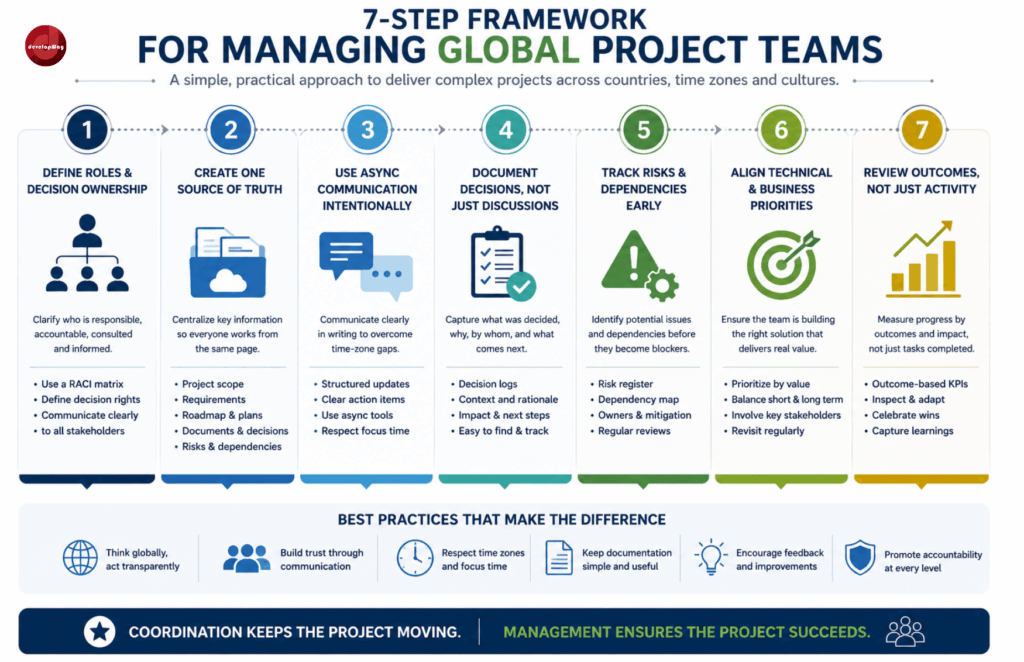
4. Document decisions, not only discussions
Many international projects lose time because decisions are discussed but not recorded. Every important decision should include what was decided; why it was decided; who approved it; what it affects; what the next action is.
Decision logs are especially useful in software, AI and R&D projects because they reduce rework and help new team members understand the project history.
5. Track risks and dependencies early
Global teams often discover problems too late.
A simple risk and dependency register should include:
- risk description;
- owner;
- probability;
- impact;
- mitigation plan;
- escalation point;
- current status.
This helps teams move from reactive problem-solving to proactive delivery management.
6. Align technical and business priorities
International projects often involve business stakeholders, technical leads, designers, developers, QA engineers and external partners. Project management should ensure that technical work remains connected to business value.
The goal is not only to complete tasks. The goal is to deliver useful, secure, scalable and maintainable software.
7. Review outcomes, not only activity
A team can have many meetings and still fail to deliver.
Progress reviews should focus on outcomes:
- Are we closer to the project objective?
- Are deliverables on track?
- Are blockers being removed?
- Are risks increasing or decreasing?
- Is the client receiving value?
- Is the technical solution still aligned with the original goal?
This mindset separates real project management from basic coordination.
What Global Teams Really Need
Global teams need coordination, but they also need ownership.
They need someone to organise meetings, but also someone to turn meetings into decisions.
They need documentation, but also accountability.
They need communication, but also risk management.
They need technical execution, but also strategic alignment.

The strongest international projects combine:
- coordination;
- technical project management;
- Agile delivery;
- stakeholder management;
- documentation discipline;
- risk control;
- clear governance;
- delivery ownership.
This is especially important for companies working with outsourced software teams, international technology partners or multi-country R&D consortia.
How DevelopWay Supports International Project Management
DevelopWay works with international clients and partners to support software development, AI-driven solutions, dedicated teams and digital product delivery.
Our experience combines technical execution with project coordination, stakeholder alignment and delivery management. This allows us to support clients not only with development capacity, but also with the structure needed to turn ideas, requirements and partnerships into working digital products.
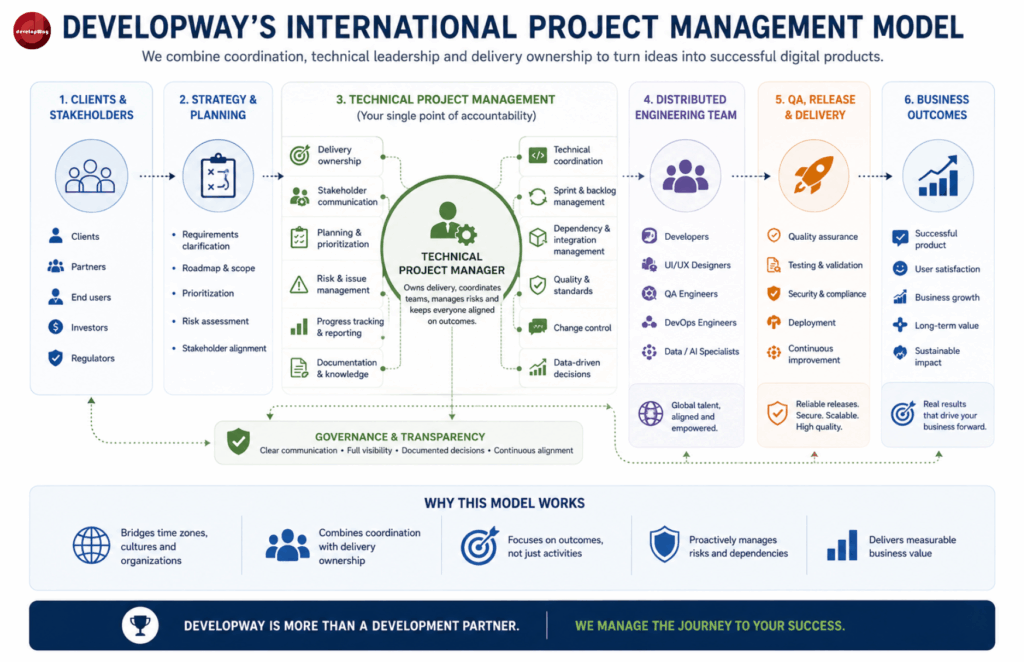
DevelopWay can support international projects through:
- technical project management;
- dedicated software development teams;
- requirements clarification;
- Agile delivery coordination;
- stakeholder communication;
- roadmap and sprint planning;
- QA and release management;
- international partner alignment;
- documentation and reporting.
For global software and AI projects, this combination matters. A strong development team can build the product, but strong project management ensures that the product is built in the right direction.
Conclusion
International project coordination and international project management are connected, but they are not the same. Coordination keeps global teams aligned. Project management creates the structure, accountability and decision-making needed to deliver results.
For simple projects, coordination may be enough. For complex software, AI, product or R&D projects, global teams need more: technical project management, delivery ownership, risk control, stakeholder alignment and clear communication.
If your company works across countries, time zones or distributed technical teams, the question is not whether you need coordination or management. The real question is how to combine both effectively.
Need a software partner that can manage international delivery, not just write code? DevelopWay helps global teams turn ideas, requirements and partnerships into working digital products.